Two companies agree to meet. One team speaks Italian, the other English. Someone suggests hiring an interpreter, and the first question arrives within minutes: which kind?
The answer changes the room, the budget and the pace of the whole meeting. The wrong mode does not just feel awkward, it slows down every decision that follows. This guide explains the main options in plain terms.
Consecutive interpreting, the conversation mode
In consecutive interpreting, the speaker talks for a minute or two, then pauses while the interpreter repeats the message in the other language. Then the other side replies, and the cycle continues.
It works well for small meetings, negotiations, factory visits and interviews. It needs no equipment, and it gives everyone time to think. The price is time. A consecutive meeting often takes close to twice as long as the same meeting in one language.
Simultaneous interpreting, the conference mode
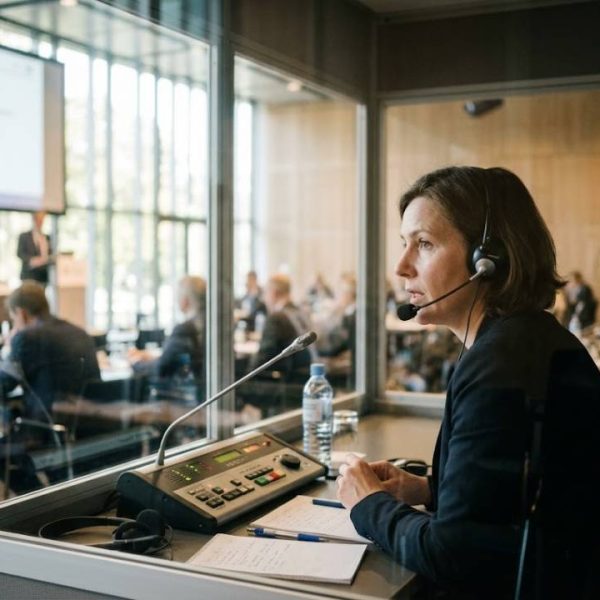
In simultaneous interpreting, the interpreter speaks almost at the same time as the speaker, usually from a booth, and listeners follow through headsets. Nobody has to stop, so a full day of talks stays a full day of talks.
It is the standard for conferences, board meetings and presentations with many participants. Interpreters in this mode normally work in pairs and swap every twenty to thirty minutes, because the mental load is high.
Whispered interpreting, a quiet option
Whispered interpreting, known as chuchotage, is a simultaneous mode for one or two listeners. The interpreter sits next to the guest and speaks softly into their ear.
It suits a visiting executive in a meeting where everyone else speaks the local language. It works for short sessions only, since the interpreter has no booth and no partner to share the effort.
Remote interpreting, when people are not in the room
Remote interpreting connects the interpreter through video or audio, either to a meeting platform or to a phone line. It saves travel and makes it possible to book a specialist at short notice.
Success depends on audio quality. A good headset, a quiet room and a stable connection matter more than the camera. Ask the provider to test the setup before the meeting starts.
For a quick overview of what providers offer across these formats, look at professional interpreting services and compare which modes they cover.
When the client cannot wait
Some conversations cannot be planned. A customer calls with an urgent problem, a supplier needs an answer, or a patient needs to be understood at once. In those cases, a short phone call with an interpreter is often the fastest path.
This guide on phone interpreting when a client cannot wait explains how it works and when it is the right choice.
Matching mode to meeting
A simple rule helps. Ten people or fewer, and the pace is relaxed: choose consecutive. More than ten people, tight schedule, or a presentation: choose simultaneous. One guest in a local meeting: consider whispered. Participants in different places: choose remote.
If your meeting mixes formats, such as a presentation followed by a negotiation, you can combine modes within one day.
Meetings are only one half of cross-border work, because almost every negotiation also produces documents that have to travel between languages. Contracts, proposals and follow-up emails need the same care as the spoken word, which is why many companies pair their interpreters with business translation services for the written side of the deal. When both halves are handled professionally, nothing gets lost between what was agreed in the room and what ends up on paper.
Prepare the interpreter, not just the room
Interpreters do their best work when they know the topic. Send them the agenda, slides, a list of participants and any technical terms in advance. A glossary of names, products and abbreviations saves the most effort.
An interpreter who sees the slides the day before sounds like an expert on the day. One who sees them when the speaker clicks to the next page can only react.
Professional standards
The international association of conference interpreters, AIIC, publishes guidance on working conditions, team sizes and professional ethics. It is a useful reference if you want to know what a serious engagement looks like.
Look for interpreters who respect confidentiality, who work in pairs for long sessions and who ask questions before the event.
Planning around time zones
Remote meetings often span several time zones. Agree on a start time in both local clocks and send a calendar invitation with the link. Interpreters need a few minutes before the start to test audio, so book them for a slightly longer slot than the meeting itself.
Record nothing unless every participant agrees, and tell the interpreter in advance if a recording is planned.
Common mistakes
Three mistakes show up again and again. Meetings are scheduled without breaks for the interpreter. Speakers talk too fast or read a script nobody has seen. Technical terms are never shared in advance.
A short briefing before the meeting solves all three.
What it costs
Interpreters charge by the hour or by the day, and simultaneous work usually costs more because it needs a team and equipment. Ask what is included: preparation time, travel, equipment and a second interpreter for long sessions.
Compare the full price, not the hourly figure. A cheaper plan that skips preparation often costs more in confusion.
The bottom line
The right interpreting mode follows the shape of your meeting. Choose consecutive for small talks, simultaneous for large events, whispered for a single guest and remote when distance is the problem.
Then brief your interpreter, share the material early and let the conversation flow.